| 25 SEPTEMBRE 2024 | ZINNEMA |
| 16:30 -18:30 | Movie screening: Behind the frontlines |
| 18:45 -19:40 | Introduction / Présentation |
| Maquis intérieurs – performative reading | |
| 19:45 – 20:30 | Friendship talk |
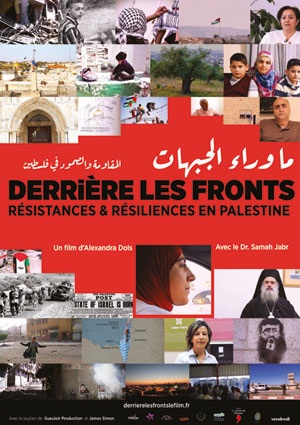
Movie screening: Behind the frontlines – Duration: 1h 54m – Language: English & Arabic – English subtitles
Behind the Frontlines offers a journey through our minds and on the roads of Palestine, in the company of psychiatrist, psychotherapist and Palestinian writer, Dr. Samah Jabr. A road movie about the invisible consequences of colonisation: the intimate occupation, that of mental space and the tools Palestinians have to face it, resist and terminate it.
“Dr. Samah Jabr is a wise and thoughtful woman. She reflects on the subtle, devastating effect on Palestinian people of years of brutal occupation. Alexandra Dols’ film shares her insights with us, generous, humane and deeply disturbing. Please see this film.” – Ken Loach
Credits: Alexandra Dols

Performative reading: Maquis Intérieurs (Work In Progress) – Duration: 1h – Language : French & English
Informal & informative performed reading: The anti-imperialist, anti-fascist, anti-racist struggles form the spirit of resistance through multiple and common paths. Some notions such as effort, perseverance, intensity exist with us in His-Her-story and reality, in religion as in politics. However, the appropriation made by Western Empires has stifled, fragmented, criminalised them: sumud صمود, jihad – جِهَاد, are 2 of the most glaring examples. From our intimate territories, from the Palestine that (pre-)occupies us to occupied Palestine, from our heartfelt commitments and rhetorical weapons, how can we form a plural body in the midst of atomizing and globalised violence? Araba, Alexandra & Milady are in search of hypotheses of reappropriation of lexicon, collective spaces and temporalities in our very intestines. Where and how are our inner maquis?
Since Yvonne Sterk, with Imbratoura and other voices invoked by political and poetic friendships. – Samah Jabr, June Jordan, Basil Al-Araj, Amiri Baraka, Jean Sénac, Nadia Zinai, … all 3 maquisards will raise retrospective figures and gestures of objection.
Credits: Araba bni Snassen, Alexandra Dols & Milady Renoir + poets and researchers (see printed leaflet for all references)
Yvonne Sterk: radiocampus.be/carte-blanche-fedaya-yvonne-sterk-sam-10-02-24-18h/
Imbratoura: alexandradols.com/fr/realisations/view/11/imbratoura
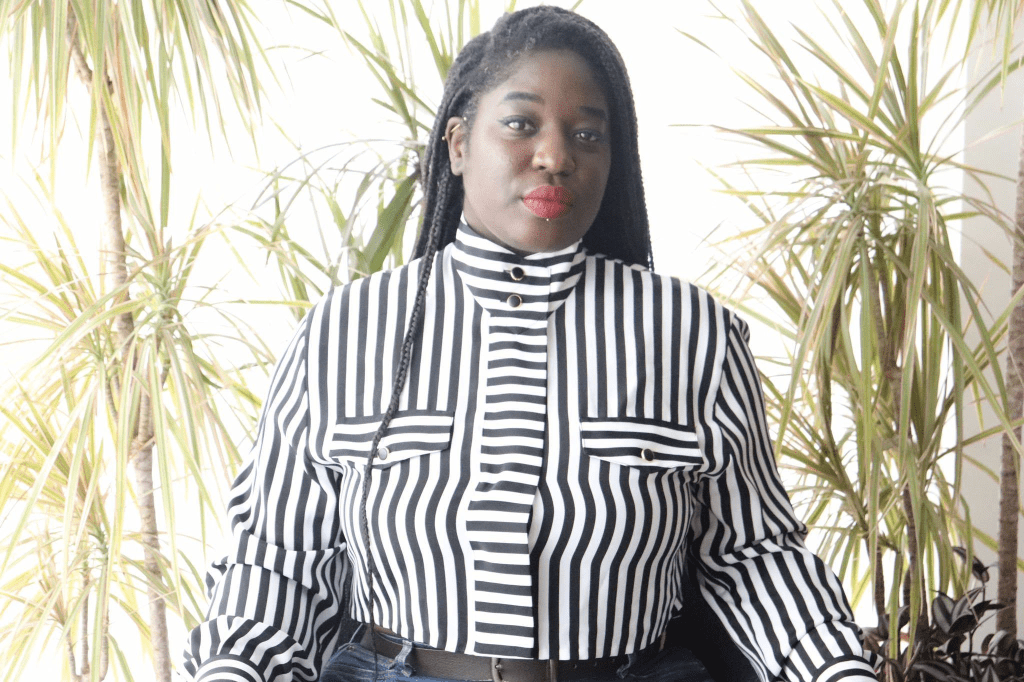
Aftertalk with: Aru Lee Amongst many things Aurélie Disasi , also known as Aru Lee is a poet and workshop coordinator. Their workshops and performances have travelled through local and international cultural spaces based in the Uk, Amsterdam, Berlin, Belgium and Finland. Through their poetry they like to evoke topics that raise awareness about intergenerational and cultural differences, mental health and care practices. This work has also led them to working as a dramaturg within institutions such as KVS (Koningklijke Vlaams Schouwburg), Fame Festival and MDF the Label. Aru lee recently worked as the field coordinator for a research project called System Turfu, where thematics on the power of the imagination, world building and economical futures within the cultural sector were explored through creative writing. They not only see poetry as a way to the liberative self expression but also as a tool for social justice.
Araba, Alexandra and Milady have met Aru Lee in various spaces and times. Milady and Aru have worked on a speculative narration project with some Brussels’ artists with system_D festival. Araba, Milady and Aru participated actively in the *Resistance festival’s 2nd edition. Alexandra and Aru are still encountering each other on common backgrounds from queer perspectives.
*charleroi-pourlapalestine.be/index.php/2024/05/22/ce-we-a-bruxelles-le-festival-resistance/
our private island-s:
FR
Notre « private island » est peu fréquentée, pas privée même plutôt ou verte. Pour accoster, on emprunte un maquis-radeau arborant plusieurs drapeaux indépendantistes de territoires non-alignés. Quand il lève l’ancre, il navigue entre Dar es Salam encore vibrante de sa révolution de 1962 jusqu’à Ikaria l’île rouge, sur laquelle se niche, au sein de la Montagne Sombre encore en activité volcanique, une bibliothèque exponentielle nourrie de chaque récit de passager·e, des plants bouturés d’oliviers millénaires, des sacs de latérite, un panier de grenades et pastèques sucrées et des cartes apocryphes.

Drone photograph of Shark Island seen from northeast. Authorities are planning an expansion of the port, threatening the preservation of Shark Island as a site of contemplation. (Forensic Architecture/Forensis, 2024)
EN
Our « private island » is not very busy, not even private, even rather open. To dock, we take a maquis-raft displaying several independence flags of non-aligned territories. When he weighs anchor, he sails between Dar es Salaam, still vibrant with its 1962 revolution, to Ikaria, the red island, on which nestles, within the Dark Mountain still in volcanic activity, an exponential library nourished by each passenger’s story, cuttings of thousand-year-old olive trees, bags of laterite, a basket of sweet pomegranates and watermelons, and apocryphal maps.
dark-mountain.net/about/manifesto/ + forensicarchitecture.substack.com/p/how-hind-rajab-was-killed-and-memories + antiatlas.net/
Qui sont ces maquisardes?
- Alexandra Dols: alexandradols.com/fr/bio La question boussole d’Alexandra Dols est celle de la libération des peuples et de la libération de soi face à un pouvoir protéiforme. Diplômée d’un Master en création et réalisation audiovisuelle à Paris VIII et d’un Master en écriture de scénario Paris I Panthéon-Sorbonne, Alexandra Dols est autrice, réalisatrice et performeuse. Au sein d’Hybrid Pulse, elle écrit et réalise des documentaires sur les luttes de libérations dans le monde arabe et en France qui trouvent de nombreux échos en France et à l’international. Pour n’en citer que certains : Moudjahidate (2007) Derrière les fronts (2017 – Sunbird Award, en sortie nationale en France, le film est soutenu par Ken Loach) Minimum syndical (2019). Attachée à la transmission, elle participe à de nombreuses projections débats, séminaires et conférences (Le Média TV, Université Sorbonne, Fémis, Théâtre National de Bretagne, University of Virginia, Museum of Fine Arts de Houston, Institut Français de Tunis, SOAS University (Londres), Sandberg Institutes (Amsterdam). Depuis 2010, elle conçoit des outils féministes d’éducation à l’image ; des parcours « Images et auto-défense » qu’elle déploie auprès de jeunes et d’adultes. Aujourd’hui, elle écrit et interprète une performance de science-fiction alliant texte, danse krump et vidéo : Imbratoura. Au cœur de son travail et de sa poésie, la question de l’auto-défense côtoie celle de l’ouverture des imaginaires.
- Araba bni Snassen vit entre les terrils liégeois et le massif de Bni Snassen. Elle agit sur plusieurs fronts, depuis sa veine syndicaliste au sein d’IWW, connu pour son organisation autogestionnaire, sa transparence, son internationalisme et son usage actif de l’action directe des travailleur·ses (au sens non confiné), termes qu’on peut affubler à Araba sans scrupule. Aussi active dans d’autres collectifs, elle est une soignante du commun, du vivant, du résistant. Elle élève plusieurs enfants au milieu du fracas ambiant, nourrit des chats nomades et cuisine un des meilleurs bibimbap en hommage aux séries coréennes, telle celle qui relate les révoltes paysannes féodales. Elle poursuit l’espoir que la poésie, le soufisme et l’amour révolutionnaire soient de la même argile, et plonge depuis quelque temps dans les archives d’Yvonne Sterk avec sa comparse Milady Renoir afin de raviver les contestations depuis la Belgique contre les mécanismes colonialistes.
- Milady Renoir est poétasse™, performeuse et animatrice d’ateliers d’écriture depuis 2004 auprès de personnes blindées d’histoires à raconter-écrire-crier. Elle anime également des formations auprès de profesionnel·les d’orgas culturelles, d’éducation permanente et de collectifs de luttes sociales ripostant aux violences d’Etat, Elle préfère la poésie et la scène aux non-dits et quiproquos, même s’ils sont terreau de poésie. Milady écrit pour des revues et des podcasts d’arts, de sciences humaines et d’analyse politique, s’engage cœur et âme au service de la réappropriation des droits des personnes sans papiers, chronique dans des émissions de radios, performe avec son corps de quinqua rabat-joie et écrit des plaidoyers, des slams entre deux doutes et trois urgences en gardant le thorax sensible, la gorge serrée et le poing levé – miladyrenoir.org
 La CoUrBE du CUBE