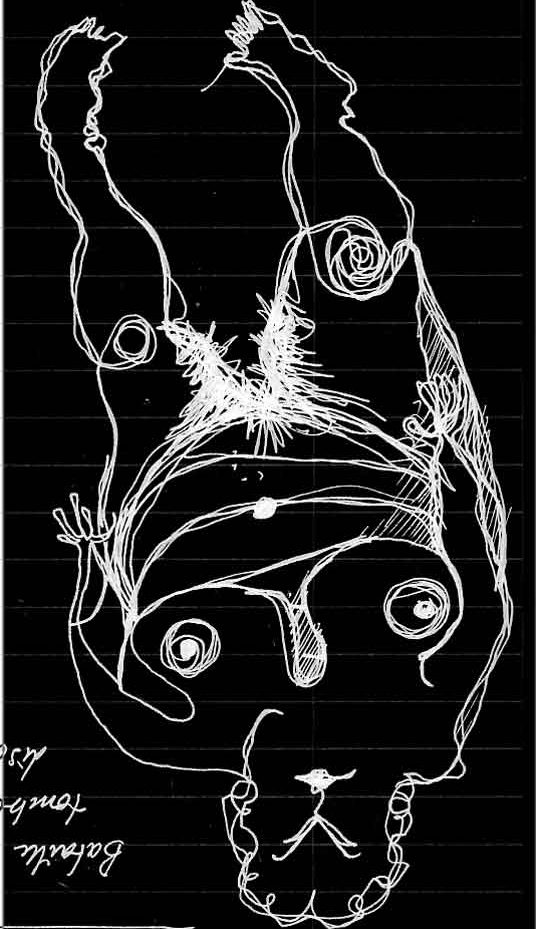
Envoy to Palestine
I’ve come to this one grassy hill
in Ramallah, off Tokyo Street,
to place a few red anemones
& a sheaf of wheat on Darwish’s grave.
A borrowed line transported me beneath
a Babylonian moon & I found myself
lucky to have the shadow of a coat
as warmth, listening to a poet’s song
of Jerusalem, the hum of a red string
Caesar stole off Gilgamesh’s lute.
I know a prison of sunlight on the skin.
The land I come from they also dreamt
before they arrived in towering ships
battered by the hard Atlantic winds.
Crows followed me from my home.
My coyote heart is an old runagate
redskin, a noble savage, still Lakota,
& I knew the bow before the arch.
I feel the wildflowers, all the grasses
& insects singing to me. My sacred dead
is the dust of restless plains I come from,
& I love when it gets into my eyes & mouth
telling me of the roads behind & ahead.
I go back to broken treaties & smallpox,
the irony of barbed wire. Your envoy
could be a reprobate whose inheritance
is no more than a swig of firewater.
The sun made a temple of the bones
of my tribe. I know a dried-up riverbed
& extinct animals live in your nightmares
sharp as shark teeth from my mountains
strung into this brave necklace around
my neck. I hear Chief Standing Bear
saying to Judge Dundy, “I am a man,”
& now I know why I’d rather die a poet
than a warrior, tattoo & tomahawk.
© 2014, Yusef Komunyakaa
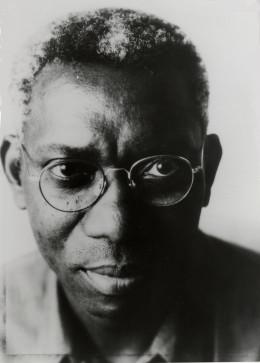
Yusef Komunyakaa
(United States of America, 1947)
Biography
Born in Bogalusa, Louisiana in 1947, Yusef Komunyakaa grew up during the Civil Rights movement and later traveled to Vietnam as a correspondent for the US Army. Komunyakaa’s poetry draws on these experiences, as Bruce Weber notes in the New York Times: “his poems, many of which are built on fiercely autobiographical details – about his stint in Vietnam, about his childhood – deal with the stains that experience leaves on a life, and they are often achingly suggestive without resolution.” His poetry questions rather than answers, often blending past and present to create complex expressions of suffering, loss and memory.
In the poems ‘The African Burial Ground’ and ‘Envoy to Palestine,’ it’s the blending of a collective past and present with the personal that haunts. ‘Envoy to Palestine’ begins with the speaker having traveled to Ramallah “to place a few red anemones/ & a sheaf of wheat on Darwish’s gave.” The lush language and images quickly turn, though:
I know a prison of sunlight on the skin.
The land I come from they also dreamt
before they arrived in towering ships
battered by the hard Atlantic winds.
Crows followed me from my home.
My coyote heart is an old runagate
redskin, a noble savage, still Lakota,
& I knew the bow before the arch.
Komunyakaa’s work frequently circles around violence. While guns and physical violence reappear throughout, it is the internal violence that fascinates, as in the poem ‘Snow Tiger,’ which ends:
If cornered in your head by cries from a cave
in another season, you can’t forget
in this landscape a pretty horse
translates into a man holding a gun.
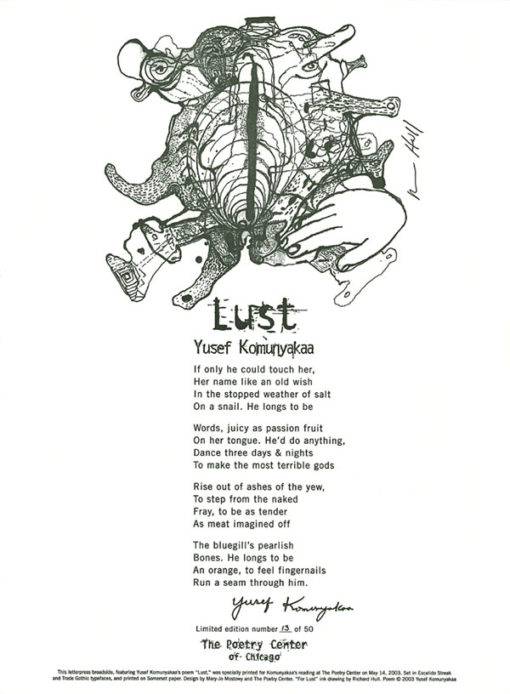
The beautiful language in a Komunyakaa poem often works like the “pretty horse” in ‘Snow Tiger,’ acting as a gorgeous carrier for the terrifying. In a series of poems on sin, Komunyakaa renders the age-old vices newly frightening in their dominance over the presumed sinners. Fiercely detailed, these poems also tempt the reader with their beautiful language, as in these lines from ‘Lust’:
To step from the naked
Fray, to be as tender
As meat imagined off
The bluegill’s pearlish
Bones.
Music, particularly jazz, pervades Komunyakaa’s poetry. Visible not only in the short, rhythmic lines of his poems, it appears also as a symbol of beauty through brokenness. In ‘Togetherness’ he writes, “I say a midnight horn/ & a voice with a moody angel/ inside, the two married rib/ to rib, note for note.” Music is both separation and unity, personal and communal. Komunyakaa’s poetry has a duende-like quality, finding artistic expression in confrontation with life’s hardships.
Komunyakaa’s recent collections include Testimony, a Tribute to Charlie Parker (Wesleyan University Press, 2013), The Chameleon Couch (Farrar, Straus and Giroux, 2011) and Warhorses (Farrar, Straus and Giroux, 2008). Komunyakaa is also the author of Gilgamesh: A Verse Play (Wesleyan University Press, 2006) and Blue Notes: Essays, Interviews, and Commentaries (University of Michigan Press, 2000). He has been awarded the Pulitzer Prize, the Kingsley Tufts Poetry Award, and the Ruth Lilly Poetry Prize, among others. Komunyakaa lives in New York City where he is currently the Distinguished Senior Poet in New York University’s graduate creative writing program.
© POETRYFOUNDATION.ORG
Islands
An island is one great eye
gazing out, a beckoning lighthouse,
searchlight, a wishbone compass,
or counterweight to the stars.
When it comes to outlook & point
of view, a figure stands on a rocky ledge
peering out toward an archipelago
of glass on the mainland, a seagull’s
wings touching the tip of a high wave,
out to where the brain may stumble.
But when a mind climbs down
from its high craggy lookout
we know it is truly a stubborn thing,
& has to leaf through pages of dust
& light, through pre-memory & folklore,
remembering fires roared down there
till they pushed up through the seafloor
& plumes of ash covered the dead
shaken awake worlds away, & silence
filled up with centuries of waiting.
Sea urchin, turtle, & crab
came with earthly know-how,
& one bird arrived with a sprig in its beak,
before everything clouded with cries,
a millennium of small deaths now topsoil
& seasons of blossoms in a single seed.
Light edged along salt-crusted stones,
across a cataract of blue water,
& lost sailors’ parrots spoke of sirens,
the last words of men buried at sea.
Someone could stand here
contemplating the future, leafing
through torn pages of St. Augustine
or the prophecies by fishermen,
translating spore & folly down to taproot.
The dreamy-eyed boy still in the man,
the girl in the woman, a sunny forecast
behind today, but tomorrow’s beyond
words. To behold a body of water
is to know pig iron & mother wit.
Whoever this figure is,
he will soon return to dancing
through the aroma of dagger’s log,
ginger lily, & bougainvillea,
between chants & strings struck
till gourds rally the healing air,
& till the church-steeple birds
fly sweet darkness home.
Whoever this friend or lover is,
he intones redemptive harmonies.
To lie down in remembrance
is to know each of us is a prodigal
son or daughter, looking out beyond land
& sky, the chemical & metaphysical
beyond falling & turning waterwheels
in the colossal brain of damnable gods,
a Eureka held up to the sun’s blinding eye,
born to gaze into fire. After conquering
frontiers, the mind comes back to rest,
stretching out over the white sand.
© 2012, Yusef Komunyakaa
Bibliography
Poetry
Dedications and Other Darkhorses, RMCAJ, 1977
Lost in the Bonewheel Factory, Lynx House Press, Amherst, 1979
Copacetic, Wesleyan University Press, Middletown, 1984
I Apologize for the Eyes in My Head, Wesleyan University Press, Middletown, 1986
Toys in a Field, Black River Press, 1986
Dien Cai Dau, Wesleyan University Press, Middletown, 1988
February in Sydney (chapbook), Matchbooks, 1989
Magic City, Wesleyan University Press/University Press of New England, 1992
Neon Vernacular: New and Selected Poems, Wesleyan University Press/University Press of New England, 1993
Thieves of Paradise, Wesleyan University Press/University Press of New England, 1998
Talking Dirty to the Gods, Farrar, Straus and Giroux, New York, 2001
Pleasure Dome: New and Collected Poems, Wesleyan University Press, Middletown, 2001
Taboo, Farrar, Straus and Giroux, New York, 2006
Gilgamesh: A Verse Play, Wesleyan University Press, Middletown, 2006
Warhorses, Farrar, Straus and Giroux, New York, 2008
The Chameleon Couch, Farrar, Straus and Giroux, New York, 2011
Testimony, a Tribute to Charlie Parker, Wesleyan University Press, Middletown, 2013
 La CoUrBE du CUBE