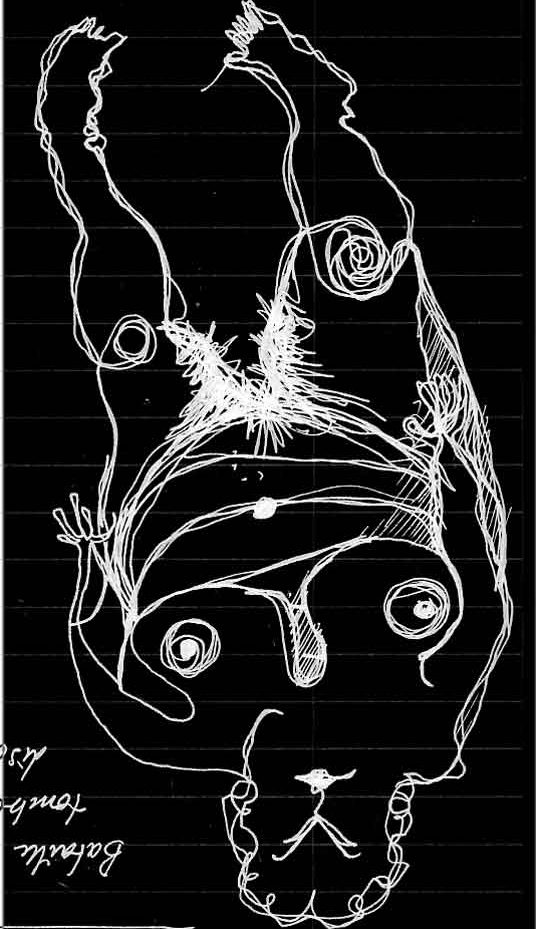
TRANSLATED BY DANIEL OWEN
« Someone has disappeared. But someone has shattered too. The president is in the hospital. His hands and throat spout saws. But the house of representatives must be rebuilt. Like building a sun from banana leaves. Someone has disappeared. The earth pukes up their body. Soldiers’ boots spill from their mouth. Someone has disappeared. A corpse stink permeates the parliament building, the kitchen too. The president must be rebuilt. The cabinet must be rebuilt. But someone has disappeared. A politics made of saws covers their eyes. The earth pukes. No longer can it yield plants. Someone has shattered. The plants puke. No longer can they bear fruit. The forest burns itself down. Buildings burn themselves down. Someone burns, is burnt down. Someone is raped. The country is raped. Someone has disappeared, I kidnap myself. Parliament must be built. A student relinquishes their body before the dictator button. Someone has disappeared! Burnt corpse. A faith that stores corpses. Some language threatens your throat. A shattered faith. Children can’t drink milk, can’t go to school. Books too pricey. Paddy fields no longer bear fruit. Some volcano erupts. The people must be built. Demos must be built. Some torture site. Bones dug from your throat. The doors of parliament sawed open. Some sun, softly, built from banana leaves. Come here. Listen. This country is for you. Don’t look at me like that. I’m a corpse. A corpse of politics. I was kidnapped. Tortured. Don’t bury me like that, like burying this country. Don’t. Come here. Listen. This is my hand. Still warm. Like a bandage of politics to cover your eyes. Come here. Come. Still have another hundred years in this place, here, on this land. »
Afrizal Malna from Indonesia
These poems come from Afrizal Malna’s 2002 book No Dog in My Mother’s Womb, which collects poems written between 1997 and 2001. This was a time of social upheaval and transition in Malna’s native Jakarta that saw the devastating economic effects of the 1997 financial crisis, coupled with the mass social movement for democratic reform, contributing to the fall of General Suharto’s 32-year New Order military dictatorship in May 1998. In the poems gathered here, we find a poetics of slanted witness, an imaginative depiction of the sociopolitical scenes playing out on the streets of Jakarta and the environs rendered through a shifting series of images, utterances, and facts.
No Dog in My Mother’s Womb is something of a culmination of the heavily repetitious, polyvocal prose poem style of his 90s work. Afrizal describes his method of this period as one of ‘thinking in images’ rather than thinking in concepts, a practice of collage-like recontextualisation of words and their associations intended to help break out of the authoritarian tendencies inherent in language, tendencies that were especially exacerbated by the New Order’s attempts at totalitarian thought control through linguistic and cultural policy.
No Dog in My Mother’s Womb also signals a turning point in Malna’s life and writing. Following its publication, he stepped away from the world of literature for several years to work as an activist with the Urban Poor Consortium, a nongovernmental organisation that supports Jakarta’s urban poor in their struggle for self-determination in the face of developmentalist policies that threaten their livelihoods and homes.
Published in
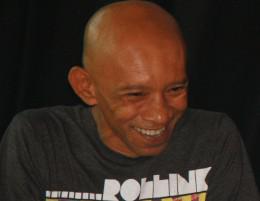
Afrizal Malna
(Indonesia, 1957) © Fitri Setyaningsih
Biography
Afrizal Malna was born in Jakarta in 1957. He studied for a time at the Driyarkara College of Philosophy in Jakarta before dropping out. In common with the work of Joko Pinurbo, a prominent theme in Afrizal Malna’s poems is the material aspects of urban existence. He is fond of juxtaposing images from daily life in a noisy, almost chaotic, manner, and the titles of some of this poems reflect this: ‘Anthropology of Coca-Cola Cans’, ‘Red Fanta for the Gods’, ‘Migration from the Bathroom’, ‘English Lesson on Body Weight’. He seems keen on finding links between objects in his poems, seeking – in his own words – a “visual grammar of things”. This intimation of secret connections among objects informs much of his poetics.
Stylistically, Afrizal’s poetry is characterised by syncopated rhythms, non sequiturs, and broken sentences. Early in his poetic career, he occasionally seemed to delight in simply listing a string of mixed images in his poems. Objects also frequently metamorphose in his work. Afrizal likes to revise his poetry, and may rewrite a poem over and over, even when earlier versions have already been published.
kerosene stove wick in the ear
there is a yellow color spouting in my heart. why
did you come too early and put on those yellow
ears? no. i did not come, not too early, nor did i
put on yellow ears. i’m just the yellow color in
your heart.
why do you address me like that, as though
letting the needle of time insert the wick of a
kerosene stove into my ear? give me another
minute to strike a safety match. give me some
time to wash my feet before leaving. just a
minute to buy a bottle of kerosene. just a minute
to see the fire light up the dark pit of my ear, so i
can see the needle of time that has fallen into
that dark pit. so i can feel time the way i sniff the
odor of raw meat in the dark pit.
no. i will not let you go. i did not let you come
either. i am only looking at the wick of the
kerosene stove burning in your ear.
i only see fear, greatly aged, living in that dark
pit.
© Translation: 2010, Nukila Amal
sumbu kompor di lubang telinga
ada warna kuning memancar di jantungku. kenapa
kau datang terlalu cepat, dan menggunakan kuping
berwarna kuning? tidak. aku tidak datang dan tidak
terlalu cepat dan tidak menggunakan kuping
berwarna kuning. aku hanya warna kuning di
jantungmu.
kenapa kau memanggilku seperti itu, seperti
membiarkan jarum waktu memasukkan sumbu
kompor ke dalam lubang kupingku. beri aku waktu
satu menit lagi untuk menyalakan korek api. beri
aku waktu untuk membersihkan kakiku sebelum
pergi. sebentar saja untuk membeli satu botol
minyak tanah. sebentar saja untuk melihat api
menerangi lubang kupingku yang gelap, biar aku
bisa melihat jarum waktu yang jatuh dalam lubang
yang gelap itu. biar aku bisa merasakan waktu
seperti mencium bau daging mentah dalam lubang
yang gelap itu.
tidak. aku tidak membiarkan kamu pergi. aku juga
tidak membiarkan kamu datang. aku hanya sedang
melihat sumbu kompor yang terbakar di lubang
kupingmu.
aku hanya melihat usia ketakutan yang terlalu tua
hidup dalam lubang gelap itu.
© 2008, Afrizal Malna
From: Teman-Temanku dari Atap Bahasa
Publisher: Lafadl Pustaka, Yogyakarta
He also occasionally writes short stories, and has published two prose books, Novel yang Malas Mengisahkan Manusia (A Novel Reluctant to Tell of Humans, 2003) and Lubang dari Separuh Langit (A Hole from Half the Sky, 2004). His poetry collection Teman-Temanku dari Atap Bahasa (My Friends from the Roof of Language, 2008) was chosen as the best literary work of 2009 by the Indonesian news magazine Tempo. Afrizal Malna took part in Poetry International Festival in Rotterdam in 1996.
© Hasif Amini
Bibliography
Poetry in Indonesian
Abad yang Berlari (The Runaway Century), Penerbit Altermed, Jakarta, 1984
Yang Berdiam dalam Mikropon (The Silent One inside the Microphone), Medan Sastra Indonesia, Jakarta, 1990
Arsitektur Hujan (Architecture of Rain), Bentang Budaya, Yogyakarta, 1995
Kalung dari Teman (Necklace from a Friend), Grasindo, Jakarta, 1999
Dalam Rahim Ibuku Tak Ada Anjing (In My Mother’s Womb There Are No Dogs), Bentang Budaya, Yogyakarta, 2002
Teman-Temanku dari Atap Bahasa (My Friends from the Roof of Language), Lafadl Pustaka, Yogyakarta, 2008
Pada Bantal Berasap (On the Smoking Pillow), Omahsore, Yogyakarta, 2010
Prose in Indonesian
Novel yang Malas Menceritakan Manusia (A Novel Reluctant to Tell of Humans), IndonesiaTera, Magelang, 2003
Lubang dari Separuh Langit (A Hole from Half the Sky), AKY Press, Yogyakarta, 2004
Poetry in English
Biography of Reading, 1995
Essays
Sesuatu Indonesia: Esei-esei dari pembaca yang tak bersih (Something Indonesia: Essays from an impure reader), Bentang Budaya, Yogyakarta, 2000
Featured in anthologies
Traum der Freiheit Indonesien 50 jahre nach der Unabhangigkeit, ed. Hendra Pasuhuk & Edith Koesoemawiria, Koeln, 1995
Frontiers of World Literature, Iwanami Shoten, Tokyo, 1997
Poets, Friends Around the World, Mitoh-Sha, Tokyo, 1997
Menagerie 3, ed. John H. McGlynn, Lontar, Jakarta, 1997
Do Lado Dos Ollos Arredor da poesia, entrevistas con 79 Poetas do Mundo, ed. Emilio Arauxo, Edicions do cumio, 2001
 La CoUrBE du CUBE