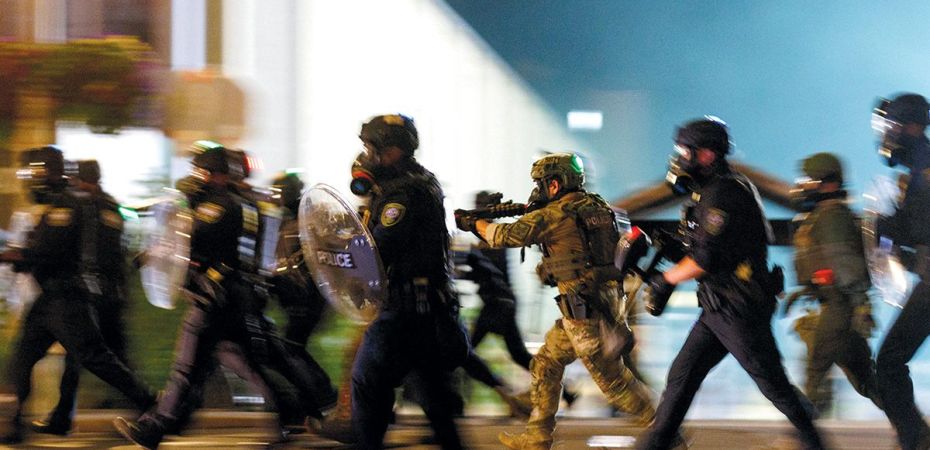
The Trump administration’s war on immigrants continues, with a less public show of force but still deadly impact. In June, immigration agents carried out the most arrests since Trump took power, further swelling overcrowded detention centers that are rife with abuse. In July, agents shot and killed two people in traffic stops in Texas and Maine.Six months ago, the wave of anti-ICE organizing in major cities reached a high point with Minnesota’s magnificent resistance to the invasion of armed and masked federal agents. But how will a movement that showed it could force the Trump regime to back down respond to the government’s new, stealthier tactics? In Issue No. 11, Hadas Thier asked more than two dozen organizers in cities around the country this question: What’s next? What lessons can be learned from how the resistance in Minnesota and beyond came together? How can activists adapt their strategies to confront the war on immigrants taking place in the shadows? You can read Hadas’s report from the front lines here — and read excerpts from it below.Hammer & Hope brings you news and analysis of today’s struggles that you won’t read anywhere else. Will you help sustain us as an indispensable source of information and ideas? INSIDE THE NATIONWIDE RESISTANCE TO THE ICE INVASIONSThe mass popular opposition to ICE “surges” led to a sea change in public opinion. Now organizers are asking: What’s next?Hadas ThierFor more than a year, hundreds of thousands of people of color have been terrorized by the Trump administration’s campaign of detentions, deportations, and violence. This reign of terror — centered on “surges” of heavily armed, masked agents carrying out aggressive arrests in urban centers, rather than the previous focus on detentions at the border and transfers from jails — led to a quadrupling of immigration arrests and a fivefold increase in deportations during the first year of Trump’s second term. The war on immigrants is taking place everywhere, but the administration had especially cruel treatment prepared for liberal sanctuary cities: first Los Angeles last summer; then the federal takeover in Washington, D.C.; then ICE surges in Chicago and Portland, Ore.; and finally Minnesota’s Twin Cities.But these surges were met by a determined resistance that spread across the country and only grew more committed and better organized as ICE and Border Patrol violence escalated. Like the “whirlwind” moments described by the famed community organizer Saul Alinsky and his protégé Nicholas von Hoffman, the nationwide movement against ICE reached deeply into neighborhoods and diverse communities, moving tens of thousands of people into action — from heroic confrontations with federal agents and complex mutual-aid networks to massive demonstrations such as the Jan. 23 day of “no work, no school, no shopping” in Minnesota. A whirlwind moment “involves a dramatic public event or series of events that set off a flurry of activity,” write Mark and Paul Engler in This Is an Uprising: How Nonviolent Revolt Is Shaping the Twenty-First Century. “This activity quickly spreads beyond the institutional control of any one organization. It inspires a rash of decentralized action, drawing in people previously unconnected to established movement groups.”In interviews with more than two dozen organizers in Minneapolis, St. Paul, Chicago, Washington, and Los Angeles, I learned about the structures that were built on the fly, as well as the existing relationships among diverse organizations that helped ground the resistance. Across the country, large numbers of people — some of them veterans of social movements, others newly activated — tackled longstanding questions about spontaneity and organization, silos and lanes, openness and security, and burnout and long-term organizing. Debates and disagreements that weren’t aired in the heat of the moment are now being taken up. And then there’s the million-dollar question: What’s next?The surge may be over, but organizers cannot simply move on. “When a creepy car drives by,” said a St. Paul teacher, Mara Solis, “we’re all still looking over our shoulder, making sure it’s not stopping for us or stopping for our kids.” But at the same time, she said, “we’re asking: How do we build on the movement that’s been started?”Read the essay.  WHY WAS MINNESOTA’S RESISTANCE TO ICE THE STRONGEST YET?Amina Adan, Lex Horan, Marcia Howard, Doran Schrantz, Aru Shiney-Ajay, and Hammer & HopeWe asked five organizers to take us inside the Twin Cities’ response. WHY WAS MINNESOTA’S RESISTANCE TO ICE THE STRONGEST YET?Amina Adan, Lex Horan, Marcia Howard, Doran Schrantz, Aru Shiney-Ajay, and Hammer & HopeWe asked five organizers to take us inside the Twin Cities’ response.  WAR AT HOMEAshley Gilbertson and Hammer & HopeA record of ICE’s assault on immigrants and the people’s resistance. WAR AT HOMEAshley Gilbertson and Hammer & HopeA record of ICE’s assault on immigrants and the people’s resistance.  HERE’S WHY IMMIGRATION RAIDS AT THIS LA HOME DEPOT GOT LESS EFFECTIVETracy RosenthalThe LA Tenants Union’s daily presence tries to give the city’s most vulnerable immigrant workers a measure of safety and gum up Trump’s deportation machine. HERE’S WHY IMMIGRATION RAIDS AT THIS LA HOME DEPOT GOT LESS EFFECTIVETracy RosenthalThe LA Tenants Union’s daily presence tries to give the city’s most vulnerable immigrant workers a measure of safety and gum up Trump’s deportation machine.  MINNESOTA DIARY: NOTES FROM A SOMALI MOTHER DURING ICE’S WINTER INVASIONMaryan Sheikh Abdinur MINNESOTA DIARY: NOTES FROM A SOMALI MOTHER DURING ICE’S WINTER INVASIONMaryan Sheikh Abdinur  HOW ONE OHIO TOWN IS RESISTING THE THREAT OF AN ICE RAIDTheresa Hice-FromilleSpringfield is a divided American everytown — with a Haitian community vilified by the Trump administration. Will we protect our neighbors? HOW ONE OHIO TOWN IS RESISTING THE THREAT OF AN ICE RAIDTheresa Hice-FromilleSpringfield is a divided American everytown — with a Haitian community vilified by the Trump administration. Will we protect our neighbors? |